

If you think your credit card statement is enough to survive an IRS audit, you're carrying more risk than you realize. Understanding how receipt documentation prevents audits is one of the most practical things a freelancer or small business owner can do to protect their finances. Without proper receipts, the IRS can disallow your deductions entirely, increase your taxable income, and pile on penalties and interest. This article breaks down exactly what the IRS expects, where most people go wrong, and how modern tools make staying compliant far less painful than it used to be.
Table of Contents
- Key takeaways
- How receipt documentation prevents audits: what the IRS actually requires
- Common misconceptions that put freelancers at risk
- Modern tools that make receipt management audit-proof
- Practical steps to organize receipts and reduce audit risk
- My take on why receipt documentation is a business skill, not a chore
- How Typezero keeps you audit-ready without the manual work
- FAQ
Key takeaways
| Point | Details |
|---|---|
| Receipts are your legal defense | The IRS can disallow deductions without proper documentation, leading to higher taxes and penalties. |
| Credit card statements aren't enough | The IRS requires original receipts with five specific data points, not just transaction records. |
| The $75 rule is widely misunderstood | Expenses under $75 still require supporting context and documentation in most situations. |
| Automation creates immutable audit trails | Automated systems capture approvals and records in real time, making your documentation far harder to challenge. |
| Organize now, not during an audit | The IRS expects existing records, not documents created after the fact when an audit begins. |
How receipt documentation prevents audits: what the IRS actually requires
Most freelancers assume the IRS will work with whatever records they can pull together. That assumption is expensive. The IRS has specific rules about what qualifies as valid documentation, and your bank statement alone does not make the cut.
A valid expense receipt needs five key data points to hold up under scrutiny:
- Transaction date: When the expense occurred
- Vendor identity: The name and location of the business you paid
- Line-item detail: What exactly you purchased, not just a total amount
- Tax and total: The full amount paid, including any applicable taxes
- Business purpose: Why this expense was necessary for your work
That last point trips people up the most. The IRS does not just want proof you spent money. It wants proof the spending was legitimate and business-related. A receipt from a restaurant means nothing without a note explaining who you met with and why.
Credit card statements can supplement your records, but they cannot replace receipts. The IRS expects existing documentation to be produced during an audit, not records you reconstruct after the fact. If you are recreating your paper trail because an auditor called, you have already lost significant ground.
The stakes get even higher in specific situations. For charitable donations over $250, missing required acknowledgments result in full deduction disallowance. The IRS does not accept "substantial compliance" arguments here. If one required detail is missing from the acknowledgment letter, the entire deduction disappears.
The IRS treats documentation as a binary: you either have it or you don't. There is no partial credit for almost having the right records.
Common misconceptions that put freelancers at risk
The receipt management mistakes freelancers make are rarely about laziness. They are usually about misinformation. A few widely held beliefs create real audit exposure.
The $75 myth is the most dangerous one. Many freelancers believe that any expense under $75 requires no receipt at all. The IRS $75 rule is narrower than people think. It applies to specific expense categories and still requires other supporting documentation and context. Lodging expenses, for example, always require receipts regardless of amount. And even for eligible smaller expenses, you still need some record of the business purpose.
Relying on memory is another common trap. Freelancers often think they will remember the business purpose of an expense when tax time comes. Six months later, that lunch with a potential client blends into dozens of other meals. Without a contemporaneous note, that deduction becomes indefensible.
Partial records are not better than no records. Some business owners keep receipts inconsistently, saving some and discarding others. During an audit, gaps in your records signal to the IRS that your bookkeeping is unreliable, which can prompt a deeper review of your entire return.

Real audit failures often come down to exactly this kind of documentation gap. A freelancer claims $8,000 in business meal deductions but can only produce receipts for $3,000 of them. The remaining $5,000 gets disallowed, and the resulting tax bill plus penalties can easily wipe out any benefit those deductions provided.
Pro Tip: Write the business purpose on every receipt the moment you get it. A 10-second note on your phone or the back of a paper receipt saves hours of reconstruction later.
Modern tools that make receipt management audit-proof
Technology has fundamentally changed what good receipt management looks like. The old method of stuffing receipts in a shoebox and hoping for the best is not just inconvenient. It is a liability.
Automated approval workflows generate immutable audit trails that document who approved a transaction, when it was approved, and under what conditions. Because these records are created in real time alongside the transaction, they carry far more weight with auditors than anything assembled after the fact. An audit-proof business has three core traits: automated approvals, real-time audit trail creation, and records that cannot be altered retroactively.
Here is what modern receipt management systems do that manual methods cannot:
- Capture receipt data automatically: OCR technology reads vendor, amount, date, and category from a photo or forwarded email without manual entry.
- Flag duplicates and anomalies: AI tools use image fingerprinting to detect duplicate submissions before they become problems.
- Reconcile against bank feeds: AI-driven receipt validation cross-references receipt data with your bank card transactions in real time, catching inconsistencies that manual review would miss.
- Store records with metadata intact: Digital receipts retain file metadata that serves as forensic proof of authenticity, something a scanned paper receipt cannot provide.
- Organize by category and date automatically: No more searching through folders at tax time.
| Feature | Manual method | Automated system |
|---|---|---|
| Receipt capture speed | Hours of data entry | Seconds per receipt |
| Duplicate detection | Relies on memory | AI fingerprinting |
| Audit trail creation | Reconstructed after the fact | Real-time and immutable |
| Bank reconciliation | Manual and error-prone | Automatic and continuous |
| Fraud detection | Visual check only | Metadata and feed analysis |
Mobile expense tracking apps reduce lost receipts, data entry errors, and approval delays while building a cleaner audit trail. For freelancers managing dozens of monthly expenses across multiple clients, this is not a luxury. It is the difference between a clean audit and a costly one.
Pro Tip: Forward every vendor email receipt to your receipt management system the moment it arrives. Batch processing at month-end is where receipts go missing.
Practical steps to organize receipts and reduce audit risk
Knowing the rules is half the battle. Putting a system in place is the other half. Here is how to build a receipt organization habit that holds up under IRS scrutiny.
Capture receipts immediately. The best time to document an expense is the moment it happens. Use a mobile app to photograph paper receipts on the spot. Forward email receipts to your tracking system before you close the email. Delay is where receipts disappear.
Add business purpose notes in real time. Every expense needs a brief explanation: who, what, and why. "Lunch with Sarah Chen, discussed Q3 project scope" takes 10 seconds to write and makes that deduction defensible years later.
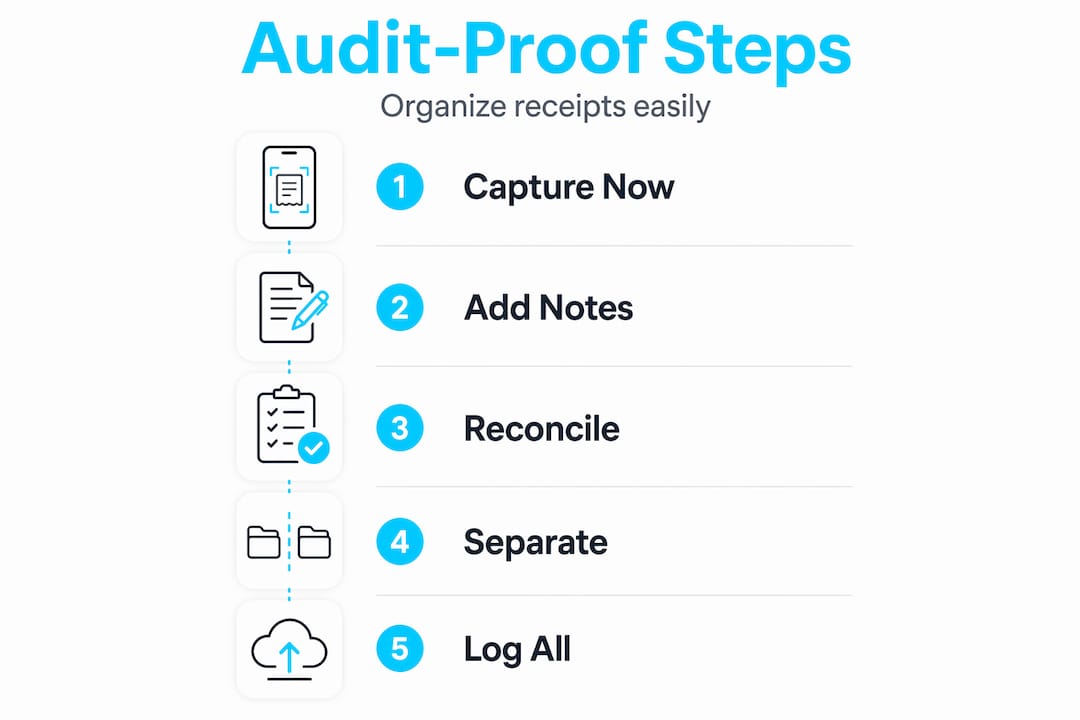
Reconcile monthly against your bank statements. Organizing records by year and type while including summaries creates efficient audit responses. A monthly reconciliation catches missing receipts while your memory is still fresh, rather than discovering gaps in April when you are already stressed.
Separate personal and business expenses completely. A dedicated business bank account and credit card eliminates the single biggest source of documentation confusion for freelancers. Mixed accounts create mixed records, and mixed records invite scrutiny.
Keep a simple expense log. A spreadsheet or your receipt management software should show every expense, its category, its receipt, and its business purpose. This log becomes your first line of defense if the IRS asks questions. It also makes handing off records to your CPA a straightforward process instead of a weekend project.
The payoff is real. Freelancers who maintain organized, contemporaneous records can respond to an IRS inquiry in hours rather than weeks. They also tend to pay lower accounting fees because their CPAs spend less time sorting through disorganized files.
My take on why receipt documentation is a business skill, not a chore
I've worked with enough freelancers and small business owners to know that receipt documentation is almost always treated as an afterthought. People think about it once a year, usually in a panic, and then forget about it again. That pattern is what makes audits so painful.
What I've learned is that the cost of a documentation gap is almost never proportional to the original expense. A missing receipt for a $200 business dinner doesn't cost you $200. It can cost you the entire deduction, plus penalties, plus the hours you spend with an accountant trying to reconstruct something that should have taken 30 seconds to document properly.
The freelancers I've seen handle audits with the least stress are not the ones who spent the most money on accounting software. They are the ones who built a simple, consistent habit around capturing and categorizing receipts as they go. Technology makes that habit easier than it has ever been, but the discipline still has to come from you.
My honest opinion is that the importance of receipt documentation goes beyond tax compliance. It tells you where your money is actually going. It gives you data to make better business decisions. And it signals to any auditor, lender, or investor that you run your business like a professional.
Start now. Not next quarter, not before tax season. The records you create today are the ones that protect you two years from now.
— Michael
How Typezero keeps you audit-ready without the manual work
Staying on top of receipt documentation is genuinely easier when the system does the heavy lifting for you.
Typezero was built specifically for freelancers and independent contractors who want organized, audit-ready records without spending hours on data entry. You forward a receipt email or upload a document, and Typezero automatically extracts the vendor, amount, date, and category. Every expense lands in a structured record that you or your CPA can access instantly. When tax season arrives or an IRS inquiry comes in, your documentation is already organized and ready to go. There is no scrambling, no missing receipts, and no guesswork. Start managing your receipts with Typezero and turn one of the most tedious parts of running your business into something that practically handles itself.
FAQ
Can receipts actually reduce my audit risk?
Yes. Thorough, organized documentation reduces the likelihood of deductions being flagged and gives you a strong defense if the IRS does inquire. Auditors are far less likely to pursue cases where records are complete and clearly organized.
Do I need receipts for expenses under $75?
Not always, but you still need supporting documentation and context for most expense types. The IRS $75 exception is narrower than most people assume, and lodging expenses always require receipts regardless of amount.
Will my credit card statement satisfy the IRS?
No. Credit card statements show that a transaction occurred but do not provide the line-item detail, vendor information, or business purpose the IRS requires. They can supplement receipts but cannot replace them.
What happens if I can't produce receipts during an audit?
The IRS can disallow the related deductions entirely, which increases your taxable income and can trigger penalties and interest on the additional tax owed. Reconstructing records after an audit begins carries very little weight.
How long should I keep my receipts?
The IRS generally recommends keeping records for at least three years from the date you filed your return, though six years is safer if you underreported income, and some records should be kept indefinitely.